Hard spend caps, enforced. The budget blocks the model call before it happens — not an alert after the money is gone. Every routing decision, cost and policy verdict is recorded and exportable.
The tooling exists for individual model calls. It doesn't exist yet for the space between them — where prompts branch, models diverge, and outputs need to reconverge.
Most tooling tells you about overspend after the model call. A retry loop on an expensive model, or a run that fans out into five image generations, is already billed by the time an alert fires. Worse, two runs starting at the same moment each check the remaining budget, each see room, and both proceed. Enforcement has to happen before dispatch and it has to be atomic — otherwise it is reporting, not a cap.
When a multi-step workflow produces garbage output — or silently returns nothing — you have no execution context to debug against. Which step failed? Which model was called? What was the exact input? Without a per-step trace, you're diffing outputs and hoping. There's no run.tasks[i].input to inspect.
Picking different models for different subtasks — claude for long-form, gpt-4o-mini for terse summaries, perplexity for retrieval — means writing if/else in your app. Routing is now coupled to business logic, untestable in isolation, impossible to change without a redeploy, and opaque to anyone on-call at 2am.
"Prompt chaining is not a system. Disconnected tools are not a platform. Real AI workflows need a layer that understands what each task requires, assigns the right model, and makes every decision observable — before, during, and after execution."
One instruction often implies several distinct tasks with different requirements. A control plane makes that structure visible and executable — your application code just submits the prompt.
Long-form writing, terse social copy, and structured extraction each have an optimal model. Hardcoding one model for everything is the fastest way to build and the slowest way to improve.
When output quality drifts or a task fails silently, you need a ledger: which task ran, which model was used, what the exact input and output were. Without that, you're guessing at causality.
Each example shows what you put in, what Prompt Tornado does behind the scenes, and what comes out.
One announcement becomes four distinct Spanish deliverables. The writing and the rewriting go to two different Claude models, the narration to a text-to-speech model and the visual to an image model.
Web research with sources, handed down a chain: a structured comparison, a risk review, a decision memo and a five-slide leadership briefing. Anything the research could not verify is marked as such.
Tickets are triaged against an approved policy (one of them tries to override it), turned into structured records, answered with reply drafts and summed up in a manager's brief. Nothing is sent: every reply is a draft.
Diagnosis, patch and tests come from one model; a model from a different vendor then reviews the fix against the spec. The tests are written, not run.
Real production runs from September 2026, with the model that ran each step. The prompts, plans and unedited outputs are on GitHub, and the live demo runs the same four.
Ten runs are free and need no card. Point it at a workflow that already costs you money, and read the trace.
Prompt Tornado turns a single instruction into a fully executed multi-step workflow — classification, routing, execution, and observation handled for you.
Write a single natural-language instruction. It can be a compound task — no need to pre-decompose it yourself.
The prompt is decomposed into discrete tasks. Each is routed to the appropriate model based on your workflow configuration.
Steps run in dependency order, each receiving the outputs it depends on. Results come back as one output — not raw completions to reassemble yourself.
Every run produces a full trace in the app: which steps ran, which model handled each, its latency and cost, and the output at each step.
Prompt in. Tasks decomposed. Models routed. Unified output returned — with a full execution trace.
Prompt Tornado logs every execution step — the model called, the provider used, duration per step, tokens consumed, cost, and the exact output. When something goes wrong, you have a ledger, not a guess.
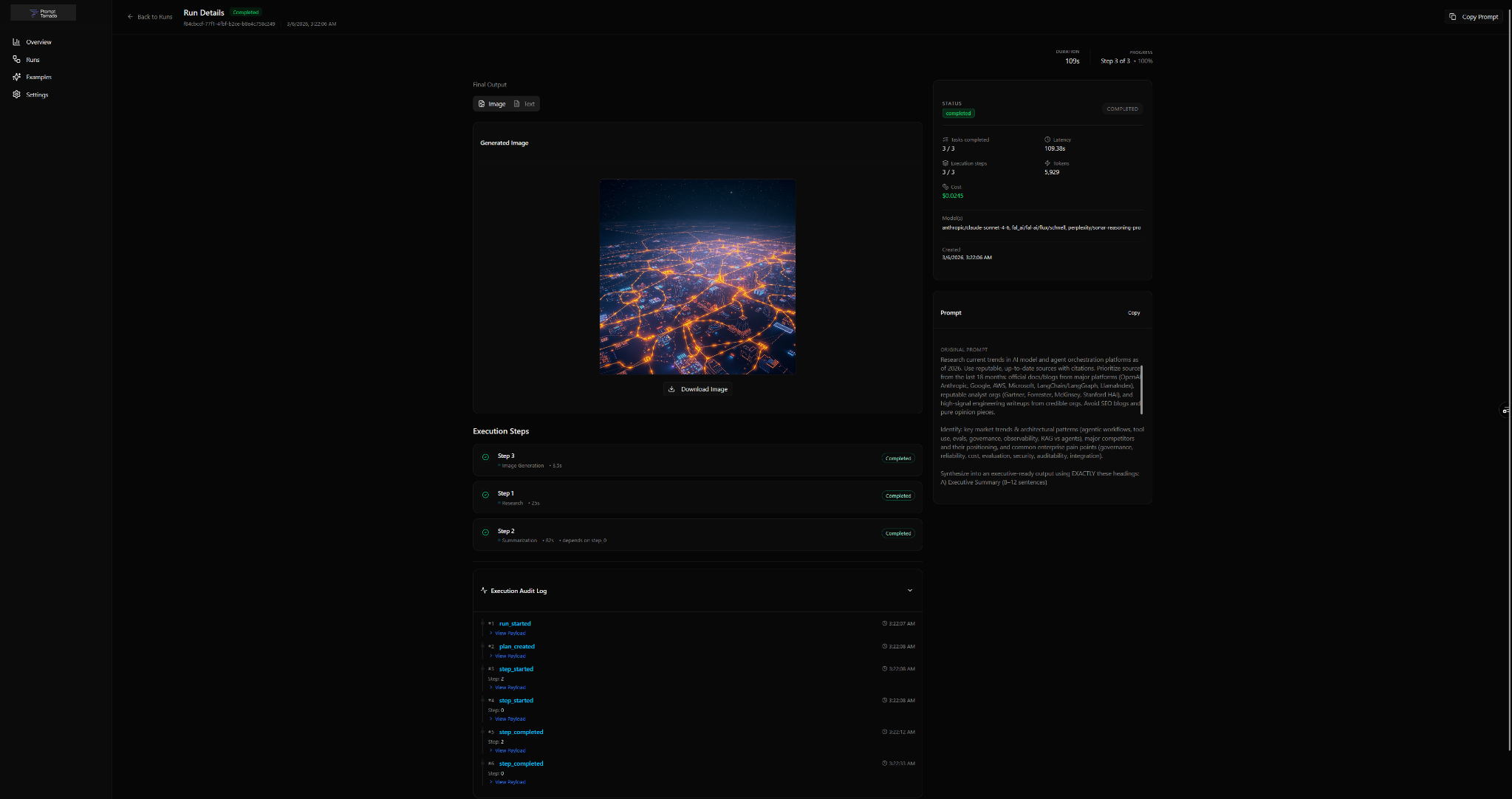
A sourced vendor comparison, a risk review, a 350-word decision memo, a five-slide leadership outline and an illustration, returned as one result. Every part is traceable to the step and model that produced it. Production run, 16 September 2026.
Beyond planning accuracy, every text-producing task type is scored 1–10 by an independent LLM judge against task-specific rubrics — and deploys are blocked on regressions. Across 181 registry task types spanning 17 categories:
181 task types · 17 categories · LLM-judged · August 2026
↓ Download the full eval report (PDF)Quality scoring measures what comes out. This is the step before it: a compound prompt becomes typed steps with dependencies, each with a ranked list of models. You can preview the plan, see its estimated cost and edit it. Then every step passes your spend cap and governance policy before it is dispatched.
Routing and provider figures from production, September 2026
Orchestration is the easy half. These are the parts that decide whether you can put it in production — and they are on the free tier too.
Every model call — text, image, audio, video — passes through one dispatch path that reserves budget first. A reservation the cap refuses stops the call before it is made, and reservations are atomic, so two runs starting at the same instant cannot both read "budget remaining" and both proceed. The one exception is an outage of the budget system itself, which on a paid plan lets the run through rather than blocking your work — stated in full on the pricing page.
Quarantine a model or a provider and new runs stop selecting it immediately. A run already in flight fails closed on its next call to that target rather than dispatching to it — and the quarantine survives a database blip instead of evaporating.
A full audit trail for every run: task-level tracing, model routing decisions, exact inputs and outputs, latency, token counts and real cost — all queryable after the fact, and exportable.
Each task goes to the model best suited for it, across six providers in automatic routing. Routing lives in the control plane rather than in your application code — change a model or a ranking without a redeploy.
Every task type has a ranked list, not a single model. If the primary fails or is unavailable, the run continues down the list — your application code doesn't need to handle the exception.
A single compound prompt becomes a set of typed, discrete tasks. The decomposition is explicit and inspectable before anything runs — not an opaque chain of inferences.
These pages help people and AI search systems understand Prompt Tornado as an AI workflow orchestration platform for multi-model routing, tracing, and evaluation.
Company and product definition, founder context, links, and the canonical description of Prompt Tornado.
Read the about page →A direct answer page explaining AI workflow orchestration, use cases, and why compound AI tasks need runtime structure.
Explore the category →How Prompt Tornado routes research, writing, code, image, audio, and structured tasks to different model providers.
See routing →Evaluation methodology, quality gates, routing checks, and the internal Prompt Tornado evaluation report.
View evaluation →A crawlable overview of the planner, task registry, model routing layer, executor, run ledger, and evaluation gate.
Open architecture →Compare Prompt Tornado with LangChain, n8n, Zapier/Make, Humanloop, LangSmith, and related AI workflow tools.
Compare tools →Prompt Tornado closes the gap between a prompt and a production AI workflow — planned into steps, routed across six providers, capped before it spends, and recorded decision by decision. It is built in the open, so you can read the traces before you read the pitch.
The workflow examples repo is live. Real use cases, full run traces, and output samples you can run locally.
→ github.com/DannyVojcak/prompt-tornado-workflowsFollow product updates, release notes, and shipped improvements for Prompt Tornado.
→ app.prompt-tornado.com/changelogThe design rationale and architecture thinking behind Prompt Tornado — written as it's being built.
→ dev.to/daniel_vojcakA recorded walkthrough of a live workflow — prompt in, task trace visible, unified output returned.
→ Watch on LoomTen runs are free and need no card. Paid plans start at $29/month.
Cancel any time. If it isn't useful in your first 30 days on a paid plan, email me and I'll refund it in full.